

This article was originally published by MyLynnwoodNews on August 10th, 2026. Written by Nahline Gouin.
Mount Rainier rises above a lake framed by evergreen trees. This is the first photograph (Untitled) I encountered in Cascadia Art Museum’s Shadows of a Fleeting World: Pictorial Photography and the Seattle Camera Club. What draws me into Dr. Kyo Koike’s gelatin silver print, however, is not the iconic Pacific Northwest landscape but its composition and atmosphere. I also wonder: How was he able to reach these remote places with all of his camera equipment in 1926?
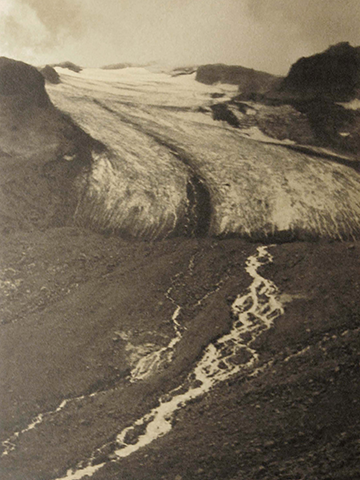
Koike’s Network of Mountain Goddess stands out to me because I’m curious about the title. Unlike his other photographs, this one seems to carry a sense of symbolism. I imagine Mount Rainier as the goddess figure and the glacier’s branching striations as the “network” referenced in the title. Its composition is also intriguing because the ambiguous sense of scale makes the mountain and glacier feel abstract.
Koike was the catalyst behind the Seattle Camera Club (SCC). As a physician, he had the financial means to support both his passion for photography and the continued viability of the SCC, while most members earned their living as cooks or shopkeepers.
His medical office was located in the Empire Hotel building on 422½ S. Main St. in Seattle, which also housed the club’s headquarters. Close by, photographers including Hiromu Kira and Yukio Morinaga worked as clerks at the Main Drug Store on 514 Main St.
These artists lived and worked in Nihonmachi, Seattle’s Japantown, now known as the International District. The Seattle Camera Club grew out of this close-knit Issei community, where they gathered in cafés, organized exhibitions and paid modest dues to maintain a reading room stocked with magazines and photography literature.
Koike also wrote frequently for photography magazines and edited the SCC’s monthly Notan, named after the Japanese concept of light and shadow.
The Seattle Camera Club was part of the pictorial photography movement. Through soft focus, composition, surface changes (like scratching on negatives) and experimental printing techniques, they rendered photographs like the paintings and drawings of the time.
It is this history that Curator David F. Martin has spent years researching. Shadows of a Fleeting World: Pictorial Photography and the Seattle Camera Club is organized in conjunction with the re-release of Martin’s book of the same title, originally published in 2011 by the University of Washington Press.
The Seattle Camera Club was an internationally recognized group of photographers active from 1924 to 1930. In the exhibition, Martin has assembled more than 70 rare, original photographs from various sources.
What makes the exhibition particularly compelling is the story behind how these photographs survived.
Martin’s extensive research into the Seattle Camera Club began in the 1980s. Around 1988, he learned about the SCC through Robert D. “Bob” Monroe at the University of Washington Special Collections. Around this time he also befriended Dennis Reed from California, who was among the first American art historians to study Japanese American photographers on the West Coast.
Martin’s research eventually expanded through conversations with artists, photographers and people who had known the photographers personally.
Through artist Yvonne Twining Humber, Martin was introduced to Myra Wiggins’ daughter, Mildred Wiggins Benz. The encounter led to something extraordinary: a trunk containing Wiggins’ photographs and carefully archived materials.
The discovery was part of a much larger network of relationships that helped Martin reconstruct the history of the Seattle Camera Club.
Architectural historian Lawrence Kreisman and John D. McLauchlan, co-founder of the Seattle Photographic Society and widower of artist Ebba Rapp, were also important to Martin’s research. McLauchlan and Rapp had been close friends of Wiggins and helped preserve her photographs as her health declined.
Martin spent a considerable amount of time undertaking research and was eventually asked to write a book about the SCC. “I know where everything is,” he said.
As I walk through the first gallery – on “rollerskates” as a professor of mine once remarked, rather than chronologically – I’m immediately drawn to Soichi Sunami’s Martha Graham in Lamentation. At first, I questioned if this was a portrait of “the” Martha Graham. Yes, it is.
Graham’s body looks sculptural, enveloped completely in fabric. Seated and sharply angled to her right, she becomes an abstract form; only her face and pointed feet are visible. Every muscle seems taut inside the fabric as she presses outward. The fabric becomes a membrane, suggesting a body struggling to break through. The photograph is captivating because of how entirely modern it feels. Even the creases in the fabric are accentuated, creating a network of striations across its surface.
Sunami worked at Ella McBride’s photography studio, where photographer Wayne Albee became a mentor to him. Through McBride’s association with Nellie Cornish’s School for Drama, Music, Dance, Sunami was, in turn, connected to Seattle’s broader artistic community. And it’s not surprising to learn that in 1930, Abby Aldrich Rockefeller invited Sunami to become the staff photographer for the newly established Museum of Modern Art (MoMA).
When McBride first moved to Seattle, she worked as a business manager for Edward S. Curtis’s The North American Indian project before opening her own photography studio in 1916 in the Lowman Building in Pioneer Square. She produced commercial portraits, fine art photography and photographic documentation for the Cornish School.
An educator, photographer, high-altitude mountaineer, studio owner and businesswoman, she was a trailblazer and also among the first Caucasian photographers to join the predominantly Issei Seattle Camera Club.
Her studio became another meeting point, hiring photographers like Sunami and Frank Asakichi Kunishige.
In the second gallery, McBride’s floral photographs line one wall, revealing an affinity with Japanese aesthetics through balance and composition. I pause in front of A Shirley Poppy, a chloride print. Displayed on an angled ledge, the different stages of a poppy are carefully arranged in a ceramic vase; and in the background, the large shadow of a flowering tree branch gives the photo the quality of an ukiyo-e woodblock print.
On a different wall of the gallery is another of McBride’s photos, The Connoisseur, a portrait of Frank Asakichi Kunishige. He wears a work coat, marked by the photographic chemicals used, over a neatly buttoned shirt and tie. His fingers also seem to be stained dark by the chemicals. More than just a portrait, the photograph honors the craft while also preserving an image of one of SCC’s important members.
Kunishige’s work received international recognition, including praise in a French review of the 1925 exhibition of the Royal Photographic Society of Great Britain, which commended his technical mastery and sensitive handling of light.
Those qualities are evident in Betti, a portrait of a woman in a fashionable hat. The hat appears as if it were lightly drawn in graphite, with even some highlights erased, while her profile is softly illuminated.
While Kunishige’s work is distinguished by his soft focus technique, another woman photographer, Virna Haffer, introduces experimentation to the exhibition.
Martin’s conversations with Haffer’s son, Gene (Jean Paul) Randall, revealed another layer of the Seattle Camera Club’s history. Randall was photographed by his mother throughout his life and helped Martin understand the world in which Haffer worked. He recalled accompanying her on visits to photographers such as Wayne Albee in California. Randall also explained the making of Self Portrait, in which Haffer photographed her reflection in a small oil-lamp reflector, creating the image’s striking distortion.
Driven to push the boundaries of photography, she experimented with unconventional processes and photograms. The fecundity of her imagination is evident in the variety of her work. Her work remains strikingly contemporary; the images feel less historical than photographs that could have been created today.
Haffer operated her own photography studio in Tacoma and at one point employed fellow SCC member Yuko Morinaga, with whom she formed a lifelong friendship. She was also instrumental in helping preserve some of his work.
After World War II, incarceration and displacement of Japanese Americans disrupted the lives of many Seattle Camera Club members. Fewer than three dozen of Morinaga’s photographs survive out of the hundreds he produced.
I instantly recognize Pioneer Square in Morinaga’s photos of 1920s Seattle. In Canyon of Streets, Seattle emerges from the shadows. The tall buildings rise like canyon walls as pedestrians move through the streets. Morinaga’s cityscapes allow light to appear sparingly. While many photographs in the exhibition use shadow subtly, Morinaga seems to reverse that relationship, allowing shadow to suffuse the scene.
Hiromu Kira uses shadows differently, turning them into abstract shapes. I find myself returning to Kira’s objects in the second gallery. Cylinders, circles, repeating patterns and reflections become carefully staged compositions, with light and shadow giving ordinary objects a sense of sculptural volume. I respond to these images in the same way I respond to traditional Japanese ceramics: the simplicity of a voluminous form with intentional markings.
In Circles Plus Triangles, the repeated lines are shadows created by light streaming through the metal object, resembling the carved striations on a Japanese ceramic plate, reminiscent of a Tokusa design.
In A Workman, the grooves of the metal cylinders echo the concentric grooves left on a wheel-thrown ceramic vessel.
In Kira’s Glasses, the cylindrical forms are again tipped on their sides, grouped with chemistry glass bottles. The reflections cast through the glass swim across elongated shadows, creating a composition that feels both curated to its last detail and unexpectedly alive.
The Seattle Camera Club dissolved in 1930 as the Great Depression strained the lives of its members, but a decade later came a far more devastating rupture. Following the 1942 Executive Order 9066, Japanese Americans on the West Coast were forcibly removed from their homes and incarcerated, facing racial stigma and discrimination. Many SCC members were sent to Minidoka in Idaho.
Who determines what survives?
The answer often lies with curators, archivists and the institutions, but also with individuals who recognize the value of what might otherwise fade from memory.
Martin’s recovery of the Seattle Camera Club’s photographs and stories required years of persistence, resourcefulness and effort, as well as ongoing correspondence.
Before typing things into Google, he had placed newspaper advertisements in places near Minidoka, hoping someone had come across materials connected to the SCC.
Those advertisements produced results. Martin estimates that approximately 20 of Kunishige’s photographs were recovered through the advertisements.
Kunishige and his wife, Gin, were incarcerated at Minidoka. After the war, they remained in Idaho for some time, where he continued exhibiting work. He eventually returned to Seattle in 1950 in declining health and died in 1960.
The Kunishige story also illustrates how photographs moved between families. Iwao Matsushita, also an SCC member, and his wife, Gin (Kunishige’s widow) donated much of their Seattle Camera Club materials to the UW Special Collections. They also donated a Kunishige portfolio to the Seattle Public Library.
Not every archive survived. After McBride’s death at age 103, her extensive archive was offered to various Seattle institutions. No other organization accepted the collection in its entirety; only the Museum of History & Industry took a selection. The remaining materials were destroyed.
An important part of Shadows of a Fleeting World is that it illuminates how fragile art histories can be. Martin’s research made visible a history that had been obscured. The exhibition also offers an opportunity to reconsider how we understand Seattle, American photography and our cultural memory.
For a brief moment, these photographs emerge from storage and are brought back into view, lit under the museum’s archival light filters. Shadows of a Fleeting World: Pictorial Photography and the Seattle Camera Club continues through Sept. 13.
You can read the original article through this link.